Reports and Analysis




Climate & Land Grabs


TIAA-Divest! Webinar Recordings

Frequent questions (but were afraid to ask)
What is divestment, and why is it important?
A. Fossil fuel divestment means freezing all new investment in fossil fuel companies and selling all owned and commingled funds that include fossil fuel public equities and corporate bonds.
Preventing fossil fuel companies from raising capital to expand their operations is crucial to keeping the planet habitable. Scientists agree that if we burned only existing fossil fuel reserves, planetary temperatures would reach catastrophic levels. And yet, fossil fuel companies continue to raise money to expand well beyond current reserves, seeking funding right now to build new pipelines, oil wells, and coal plants.
This is where divestment comes in. Just 23 investors hold 50% of all institutional investments in fossil fuel companies. The major providers of university pension plans, including Vanguard, Fidelity, and TIAA, are all in the top 16, and Vanguard is #2. These retirement managers are currently a major source of capital for fossil fuel expansion, including new coal mines.
At large scales, divestment constrains the fossil fuel industry, lowering stock prices and limiting expansion. Divestment also undermines what Bill McKibben calls the “social license” to operate.
If a pension fund sells its investments in fossil fuels, doesn’t another investor just come along and snap those up at a lower price—isn’t that just basic economics?
A. When lots of people sell stocks in fossil fuels, that drives prices down, which diminishes the capitalization of the fossil fuel sector. The first large-scale empirical analysis of divestment in equity mutual funds shows that the stock prices of the carbon-intensive companies they have ejected from their portfolios fall, and those prices remain low over time.
Perhaps more importantly, the fossil fuel industry is not operating in an abstract world of supply and demand. Coal, oil, and gas companies are wielding substantial influence in the political arena to manipulate the economy. The US, for example, pays $646 billion in subsidies to the fossil fuel companies every year. When large investors like Vanguard and TIAA have sunk our money into oil, coal, and gas, they also lobby politicians to protect fossil fuel profits. When these major investors shift their money to renewable energy, they’ll almost certainly champion renewables and more responsible climate policies—and so shift the political environment against fossil fuels, with beneficial political and economic consequences for all of us.
Wouldn’t it be more effective to move our retirement savings into ESG and other environmentally responsible funds?
A. There are many ways to pressure banks and retirement funds. Pushing retirement funds to divest is important because:
- Many academics are locked into a narrow set of retirement options and don’t have the choice to move our savings;
- Some of the “ESG,” “social responsibility,” and “low carbon” funds that are offered by large banks and retirement funds are actually filled with fossil fuels. TIAA’s “Social Choice Equity Fund,” for example, has nearly 8% invested in fossil fuels, including Conoco Phillips and Chevron, and Vanguard’s ESG International Stock ETF has over $5 million in coal and nearly $9 million in oil and gas. You may track the fossil fuel holdings of retirement funds at www.fossilfreefunds.org;
Moving individual funds has a relatively small impact on firms worth trillions of dollars. We need ongoing, public, and collective pressure as well as economic and institutional actions to shift money away from fossil fuels.
I’m worried about my own savings. Will divestment hurt my retirement?
A. Fossil fuel stocks have been performing badly for a decade. When researchers compared funds that included the worst emitting 200 coal, oil and gas companies to those that had divested, they found that those without fossil fuels fared the same or better. A 2023 study by a team of researchers at the University of Waterloo showed that public pension funds would have seen 13% higher returns—a difference of $20 billion—if they had divested from fossil fuels a decade ago.
It looks increasingly clear that investments in fossil fuels are riskier for your retirement fund than divestment. As renewable energy becomes cheaper and more governments regulate fossil fuel use, the long-term outlook for fossil fuels remains poor. The banks and pension funds that are slow to divest are very likely to be left holding “stranded assets,” such as coal mines and oil pipelines that can no longer be used, which will be worth nothing. A recent study shows that most retirement funds dramatically underestimate the financial impacts of climate change.
What about the surge in fossil fuel stocks in the past couple of years?
A. A rise in oil and gas stocks since 2022 has prompted some investors to revive their attachment to fossil fuels. But researchers have tied the surge in oil and gas profits directly to Russia’s invasion of Ukraine. According to the President of the European Central Bank, Christine Lagarde, this is precisely the reason we should increase the speed of our transition away from fossil fuels: “Reliance on coal, oil and gas is the intentional embrace of death, misery and collapse in Ukraine and at a global scale.”
Can you divest index and mutual funds?
A. Yes. There are fossil-free index and mutual funds, and these have performed well in the past decade. The S&P tracks the performance of fossil-free index funds here.
Is shareholder engagement more effective than divestment, as retirement funds such as TIAA and CalPERS have argued?
Research suggests that engagement has overwhelmingly failed to reduce emissions. The Climate Action 100+ initiative focused on the 166 companies that account for 80% of corporate emissions. After tracking several years of investor engagement, the initiative concluded that fewer than 12% of these companies had set meaningful carbon reduction targets or developed decarbonization strategies. “Just 7% have stopped lobbying against climate-positive laws and regulations. And none–0%–have aligned their capital expenditure with a 1.5 degree future or produced financial statements that reflect relevant climate risks.”
TIAA itself engaged Exxon-Mobil for years to no effect. Exxon has continued to expand fossil fuel production, and refused to disclose its Scope 3 emissions. According to The Wall Street Journal, Exxon Mobil CEO Darren Woods doubled down on his commitment to fossil fuels in December 2022. “If the world needs oil and gas, which it does, who best to produce it,” Woods said.
My institution says it can’t divest because it has a “fiduciary duty” to secure the best returns on investment.
A. Some institutions interpret “fiduciary duty” narrowly, as referring only to short-term benefits. But according to the Center for International Environmental Law, pension funds have a duty to “balance the interests of current beneficiaries with future retirees and benefit recipients, and must ensure stability while pursuing growth.” This means that “a lack of consideration of longer term climate-related risks to the plan’s portfolio could be seen as an unreasonable bias favoring short-term gain at the expense of long-term sustainability; favoring older (current) over younger (future) beneficiaries. A failure to consider climate related risks generally, a failure to take prudent steps to manage and mitigate these risks, and a failure to act to reduce long-term, climate-related portfolio drag on fund investment could constitute violations of the fiduciary’s duty to conduct factual inquiry on material investment issues, to act solely in the financial interests of beneficiaries, and to act with impartiality between current fund participant generations.”
Carbon Tracker reports that most pension funds are following erroneous predictions made by economists about the impact of global warming that are inconsistent with scientific research. Peer reviewed economic papers, for example, claim that a rise in temperature of 6°C will reduce global GDP by less than 10%, whereas scientists show that even a rise of 3° will bring catastrophic effects, and that temperatures above 5° pose a threat to human existence.
Why is deforestation included in the demands on pension funds?
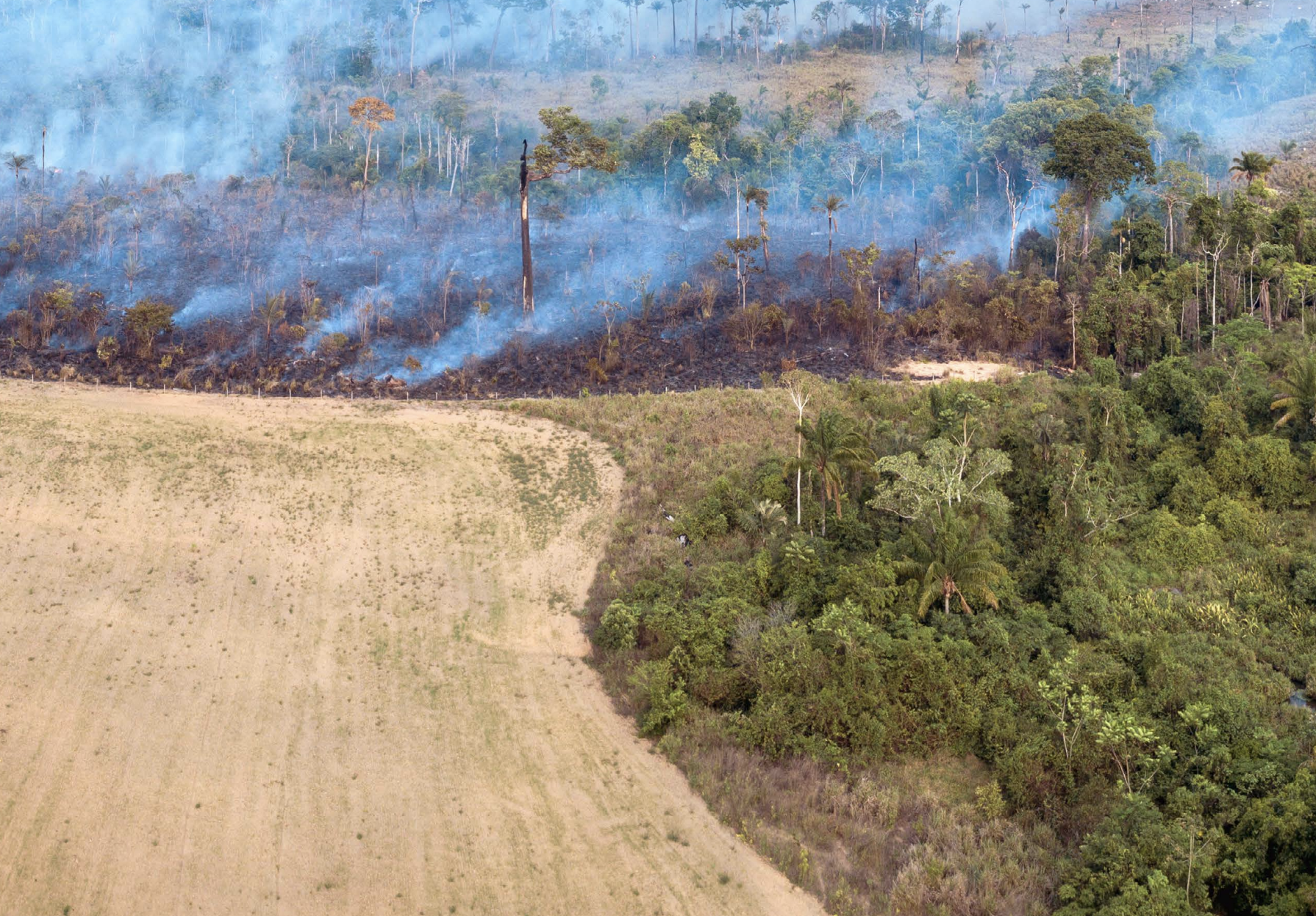
A. Deforestation is a major driver of the climate crisis. Industrial agribusinesses clear huge tracts of carbon-storing forests for monocropping, such as palm oil and soy, and for raising cattle. These businesses are estimated to contribute 12-20% of greenhouse gas emissions worldwide. Vanguard holds hundreds of millions of dollars in businesses that devastate forests. TIAA is one of the largest owners of farmland and timberland in the world, displacing local farmers and linked to human rights abuses and illegal landgrabs in the Brazilian Cerrado. TIAA and Fidelity are both heavily invested in agribusinesses that produce palm oil, paper, rubber, timber, beef and soy.