A few years ago, Cornell Professor of Natural Resources and the Environment Dr. Marianne Krasny asked a financial advisor to help her to move her TIAA retirement savings to environmentally friendly investments. He offered her two fund options. “I looked at them, and they still had all these things I hated,” she said. “But they were my only alternative. So I didn’t go further.”
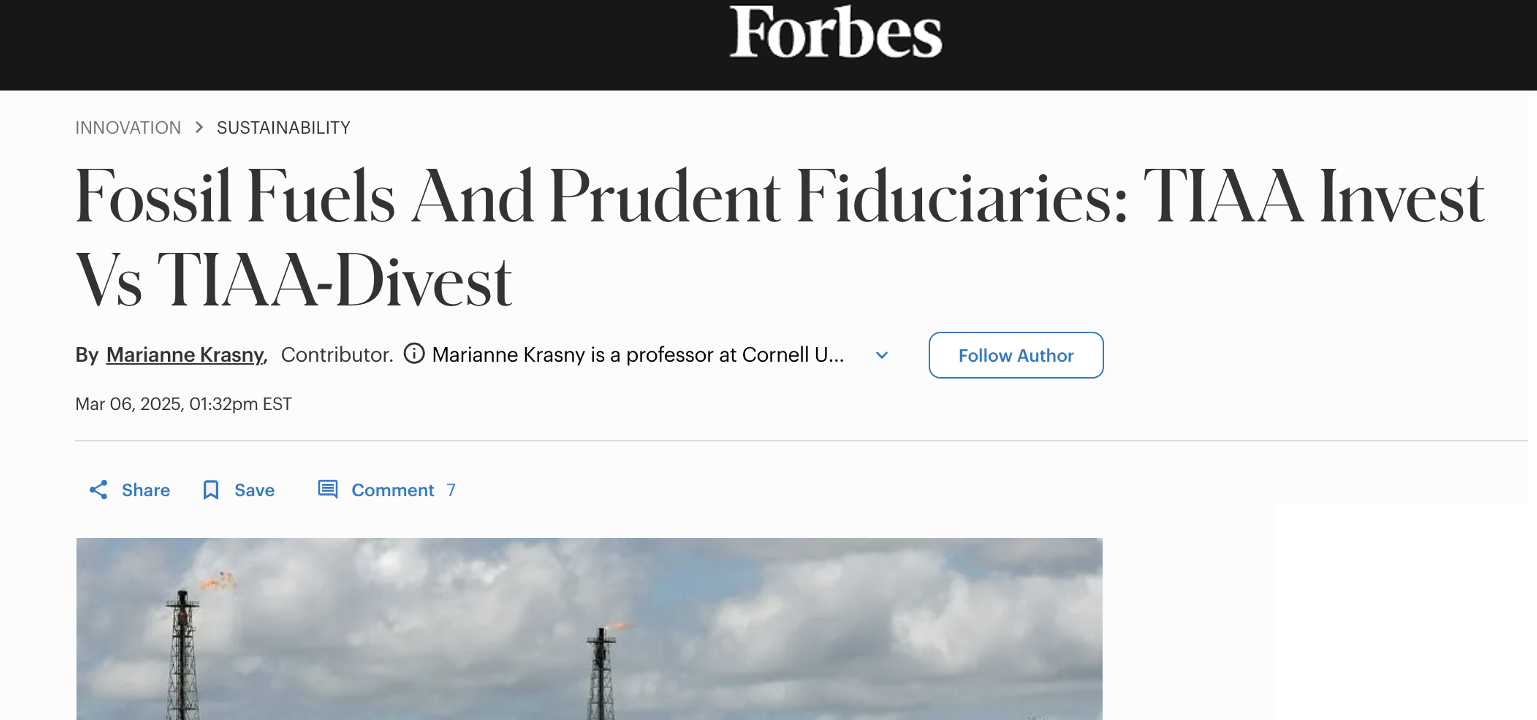
Marianne’s worries about TIAA lingered. In the regular column she writes for Forbes, she decided to investigate TIAA’s investment practices. Her powerful article, “Fossil Fuels And Prudent Fiduciaries: TIAA Invest Vs TIAA-Divest,” appeared earlier this month.
 | Marianne Krasny, Director of the Civic Ecology Lab at Cornell University, whose most recent book, In This Together: Connecting with Your Community to Combat the Climate Crisis, explores the power of “network climate action.” |
We asked Marianne what it had been like to write this article. What surprised her most was that no one at TIAA or Nuveen would respond to her questions. At first, Michael Tetuan, TIAA’s Senior Director of Media Relations, sounded as if he might be open to a meeting. But a few weeks later, he sent her a formal statement from the company to include in the article. And that was it.
“My tactic was to be very open and tell them I try to give both sides,” Marianne explained. “And they wouldn’t talk to me.”
Like a lot of us, Marianne says that she hasn’t paid close attention to her own retirement investments over the years, and for a long time she didn’t stop to think much about the company at all. “They had a good reputation.” She knew that Thomas Jones, TIAA’s CEO in the late 1990s, had been one of the African-American student radicals who had occupied Cornell’s Willard Straight Hall in 1969. Members of this group had become “amazing” leaders.
But now the company’s meager environmental investments and refusal to answer even basic questions about sustainable investing have left a bad taste in her mouth.
One of the most important challenges around sustainable investing, Marianne learned, was the problem of “fiduciary duty”—the responsibility of retirement funds to act in their clients’ best interests. Companies can be sued if they are not striving to get the best financial return for their investors. This puts them in a bind. If fossil fuels are bringing in high returns, retirement funds may be obligated to include them in their portfolio.
But Marianne’s research showed that coal, oil, and gas “are actually a bad investment.” ClientEarth attorney Ben Segal told her: “Fiduciary duties are real but fiduciary duties are not a suicide pact.”
Marianne remains troubled, too, by the likelihood that TIAA is dramatically underestimating the financial risks of climate change. As she writes in the article: “investment consultants have advised pension funds that global warming of 2-4.3°C will have only a minimal impact on their portfolios. In contrast, scientists predict that even 1°C of warming—which we have already passed—could trigger dangerous climate tipping points.”
There is no one with climate expertise on TIAA’s Board of Trustees or Governors, and the company’s massive investments in coal, oil, and gas suggest that they are not taking climate scientists’ predictions into account.
Marianne concludes that TIAA is not exercising the “duty of prudence” required of a fiduciary. She calls to mind the wildfires that devastated LA a couple of months ago, and then notes TIAA’s sluggish pledge to reach Net Zero by 2050. If you know anything about climate change, she says, “That just doesn’t make sense.”