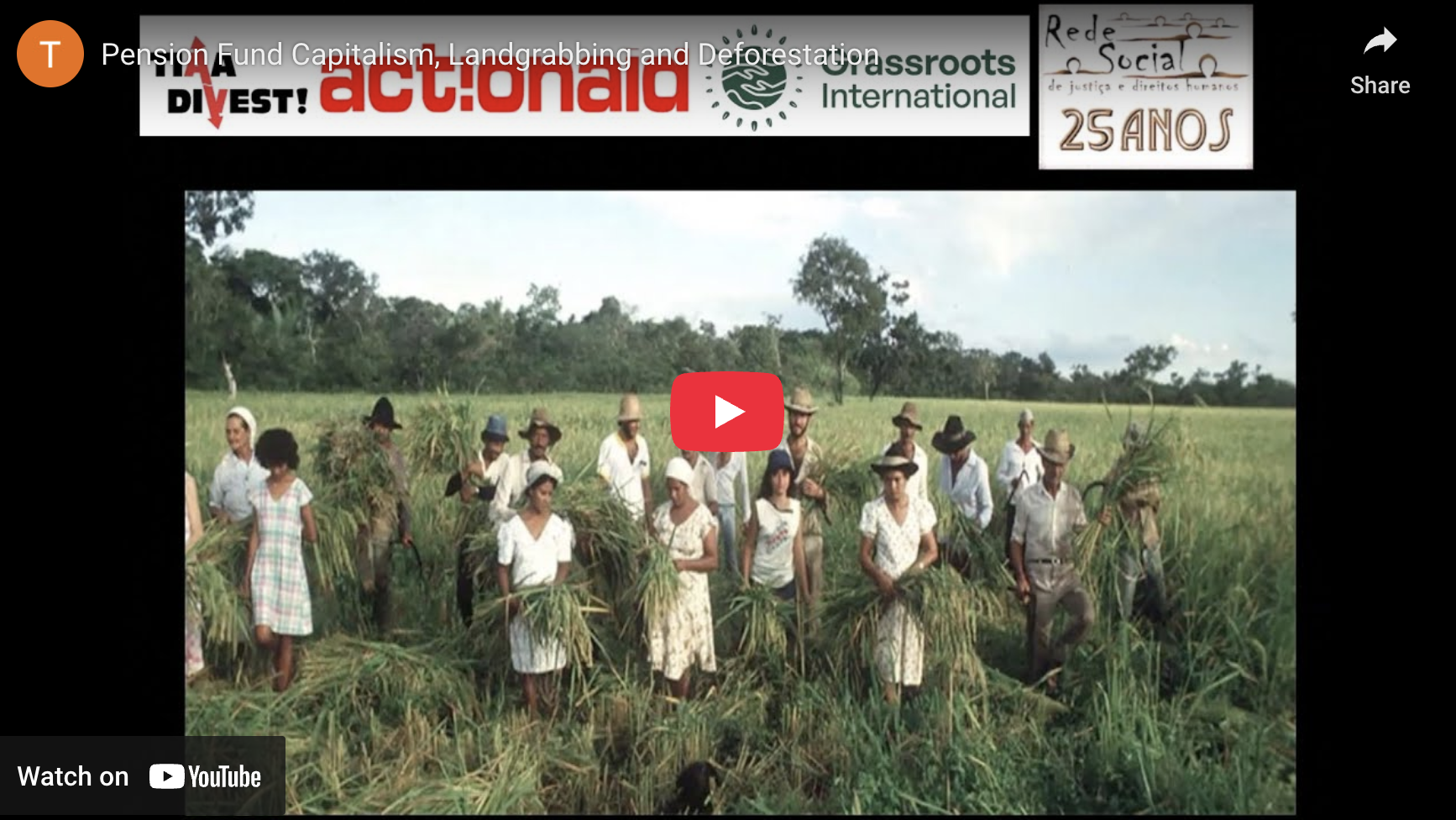
On Tuesday, April 15th, over 110 people gathered for a powerful webinar focusing on the costs of TIAA’s massive agribusiness operations in Brazil.
The event was organized by a coalition that includes TIAA-Divest!, Rede Social de Justiça e Direitos Humanos, ActionAid USA, Grassroots International, and the Stop Land Grabs coalition. Streamed live from Johns Hopkins University, this coalition brought together cutting-edge research and searing testimony from those on the frontlines of land dispossession.
The webinar was originally planned to mark the publication of a new report exposing TIAA’s role in land speculation and displacement in the state of Bahia, Brazil, where they own over a million acres. But just days before the launch, the authors received a threatening message from TIAA. Though confident in their findings, they delayed the release to provide additional context and ensure clarity.
The most searing testimony in the webinar came from a farmer from Bahia, Brazil, whose name was withheld for his safety. He explained how armed land grabbers have taken over lands cared for by generations of Indigenous and Black families. “We have very few animals per acre because we don’t have mechanization,” he explained. But agribusinesses are different: they “pour toxic insecticide onto the land and pollute. There is an absurd increase in cancer. No one here doesn’t have a member of their family with cancer.” On the water and climate impacts, his testimony was also heartbreaking: “We’ve never seen rivers dry up before, now we see that.”
TIAA operators are now erasing all traces of the people who have stewarded the land for generations. “They are kicking us out, dispossessing us, they say we don’t exist,” he said.
We encourage you to watch the webinar yourself to hear more about the scope of the harms. You’ll hear Maria Luisa Mendonça, a research scholar at CUNY’s Center for Place, Culture, and Politics, who explains that “we are building a movement. Communities are creating strategies to advance land rights, building an intersectional coalition so that creates a level of protection for communities on the land.” Mendonça has been tracking the investors, including TIAA, who are expanding monocropped plantations in Bahia, driving deforestation, climate change, community displacement, and ecosystem collapse.
Fábio Pitta, a geographer from the University of São Paulo, shows maps and photos of monocrop plantations destroying the Cerrado, one of the world’s most biodiverse ecosystems. TIAA leases land there to operators who strip deep-rooted native vegetation in favor of soy plantations for export as animal feed. One photograph of a road dividing two worlds says it all: on one side, native savannah teeming with life; on the other, a barren monocrop wasteland—no trees, no animals, no water.
Abigayle Reese, a TIAA-Divest! organizer, makes connections between TIAA’s wealth and the exploitation of Black and Brown communities. She explains how TIAA profits from a legacy of racist violence, from Brazil to the Mississippi Delta, all while cloaking its extractive practices in language about sustainability and community engagement. “TIAA’s financial success depends on maintaining the belief that they are acting in the best interests of people and the planet,” she explains.
The event includes a Q&A led by TIAA-Divest’s coordinating committee member Bill Kish, and a deep dive into TIAA’s opaque financial structures from Doug Hertzler, ActionAid USA Senior Policy Analyst and TIAA-Divest! member. As a TIAA participant himself, Hertzler calls out the corporation: “TIAA contributes to growing farm size, extracting profits from poor rural areas to financial hubs like NY and Chicago – while undermining local businesses and communities.” You can see him follow a complex web of TIAA subsidiaries designed to obscure land ownership, making it nearly impossible to trace how much land they truly control.
Once you see how industrial agribusiness is destroying human lives and vital ecosystems, we know you’ll feel moved to act.