
If you’ve ever looked at your TIAA account statement and felt like you needed a finance degree to make sense of it, you’re not alone — and you’re not wrong. These documents are genuinely complex. But here’s the good news: understanding what’s in your retirement account, and taking steps to align it with your values, is more achievable than TIAA would have you believe. A remarkable set of free, easy-to-use tools exists specifically to help TIAA participants do exactly that — no financial expertise required. This guide will walk you through what your statement actually tells you, what it deliberately leaves out, and how to use those tools to get the full picture. By the end, you’ll have a clear path forward.
Understanding Your TIAA Statement
TIAA sends participants a quarterly statement summarizing their retirement account. At first glance it can look reassuringly thorough — several pages of tables, charts, and figures. But understanding what the statement actually tells you, and more importantly what it doesn’t, is the first step toward taking control of how and where your retirement savings are invested.
Expand to see a sample TIAA statement
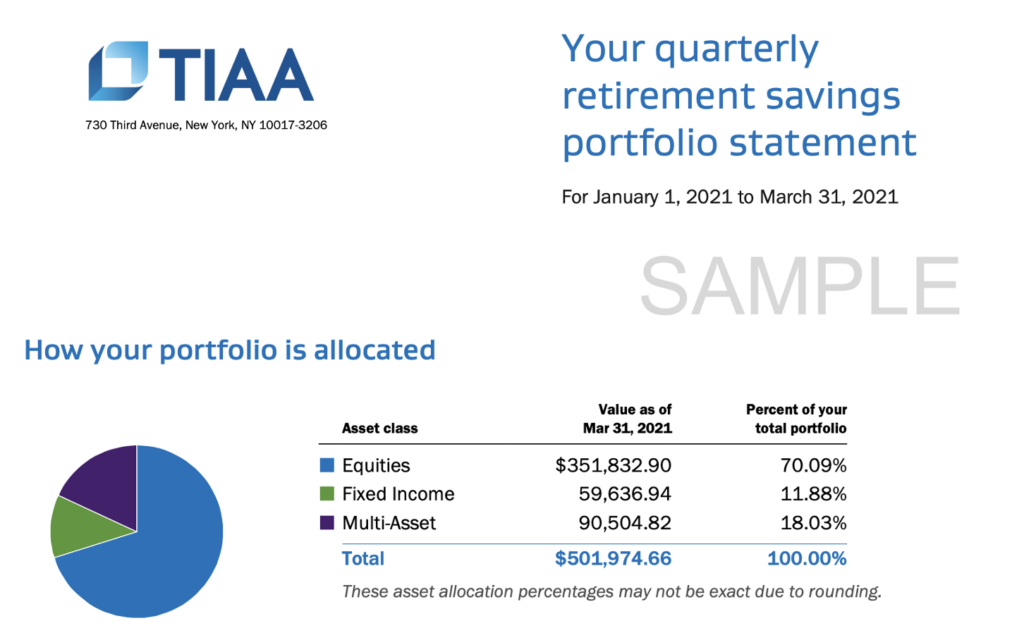
The statement opens with a Portfolio Summary: your total account balance, how much it changed during the quarter, and how it has changed since the beginning of the year. This is the number most people look at and stop there.
Below that you’ll find an Asset Allocation breakdown, typically shown as a pie chart, dividing your holdings across up to six broad categories: equities (stocks), fixed income (bonds), real estate, multi-asset funds, money market, and guaranteed accounts. This tells you something about the risk profile of your portfolio, but the categories are very broad — “equities,” for example, could include anything from renewable energy companies to major oil producers.
The bulk of the statement is the Investment Detail section, which lists each fund you hold by name, along with its current balance, the number of units or shares you own, and its performance over the quarter and year. This is where things get useful — because the fund names are your entry point to finding out what’s actually inside them. A fund called “Nuveen International Responsible Equity Fund” sounds reassuringly green (it’s not); a fund called “CREF Stock Account” tells you almost nothing. In either case, the statement itself won’t tell you whether the fund holds ExxonMobil, Chevron, or a coal mining company.
The Transaction Detail section lists all activity during the quarter: contributions from you and your employer, any transfers between funds, and any distributions or withdrawals. This is useful for verifying that your contributions are being received and allocated correctly.
Finally, somewhere in the fine print you’ll find fee information — plan administration expenses that are deducted from your account. These are often expressed in ways that make them easy to overlook: as a small percentage, or as a reduction already reflected in your balance rather than a visible line-item charge.
What you won‘t find anywhere in your TIAA statement is a list of the individual companies your money is invested in. For that, you need to look up each fund separately. Fortunately there’s a group of easy-to-use websites that can help you unpack the environmental and social impact hidden behind the unpronounceable abbreviations.
The good news
The good news is that a remarkable nonprofit has done much of the hard work for you. As You Sow is a shareholder advocacy organization dedicated to holding corporations accountable on environmental and social issues. Over the years they’ve built Invest Your Values, a free suite of screening tools that analyzes thousands of U.S. mutual funds and ETFs against a range of environmental and social criteria — and makes the results available to anyone with an internet connection. The individual tools each focus on a specific issue: Fossil Free Funds rates funds on their fossil fuel and carbon exposure; Deforestation Free Funds screens for investments linked to forest destruction; Weapon Free Funds and Gun Free Funds examine exposure to arms manufacturers and firearms retailers; Tobacco Free Funds identifies funds with holdings in tobacco companies; and Gender Equality Funds rates funds on key indicators of workplace gender equity. Each tool gives your fund a simple letter grade — making it easy to start with the issue you care about most and drill down from there. The data is updated monthly and the tools are completely free. For TIAA participants concerned specifically about fossil fuel exposure, Fossil Free Funds is the natural place to start.
Taking a Closer Look: The Nuveen Global Infrastructure Fund (FGIAX)
Let’s walk through how you’d use Fossil Free Funds to investigate a specific fund. We’ll use the Nuveen Global Infrastructure Fund, ticker symbol FGIAX, as our example — a fund that appears in many TIAA retirement account lineups and whose name gives almost no hint of what’s inside.
Start by going to Fossil Free Funds and typing “FGIAX” into the search box. You can use either the fund’s full name or its ticker symbol — either will work. Within seconds you’ll have a detailed report card on the fund’s fossil fuel exposure.
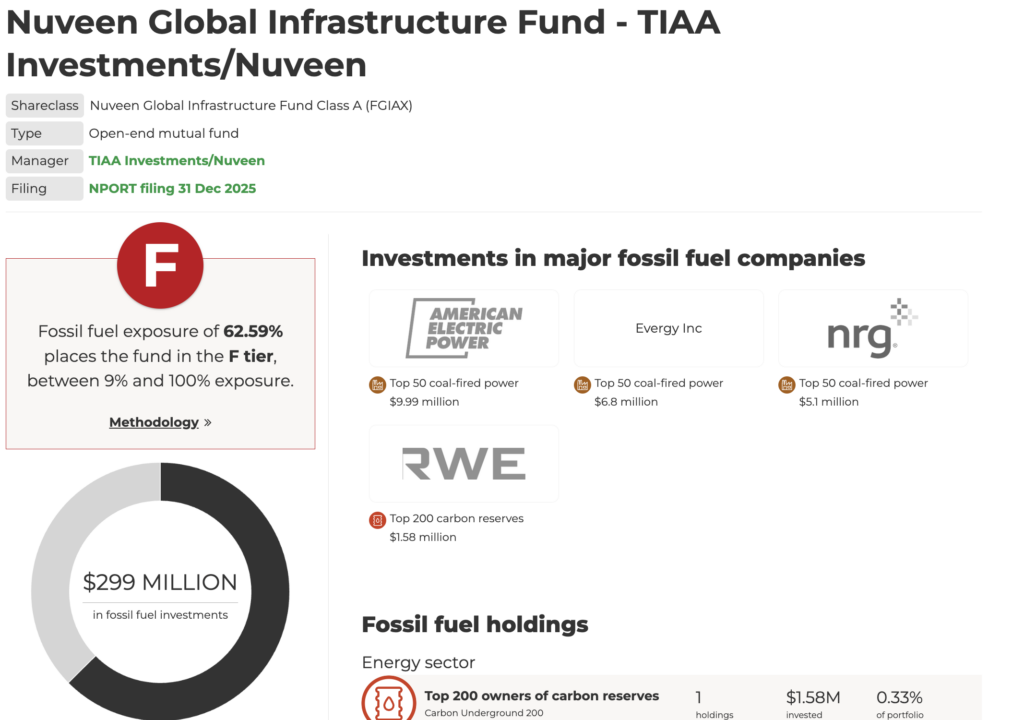
What you’ll find is not pretty. The fund invests primarily in “infrastructure” companies — which sounds reassuringly civic-minded, conjuring images of bridges, water systems, and broadband networks. In practice, according to Fossil Free Funds, 62.59% of the fund’s assets are flagged for fossil fuel exposure, earning it a grade of F — the worst possible rating. To put that in concrete terms: nearly two-thirds of every dollar you have invested in this fund is in companies that own or operate fossil fuel infrastructure, including coal-fired power plants and oil and gas producers. The fund holds 38 fossil fuel stocks, representing $299 million in fossil fuel investments.
The Fossil Free Funds report breaks this exposure down in useful detail. You can see the fund’s overall letter grade at a glance, the exact percentage of assets in fossil fuel companies, and a list of the specific holdings driving that exposure — including companies flagged as top coal-fired utilities by the Macroclimate 50 list, one of the standard industry benchmarks for identifying the most carbon-intensive power generators. You can also click through to see how the fund rates on other issues — fossil fuel finance, clean energy investments, and more — giving you a much fuller picture than your quarterly statement ever would.
None of this information appears anywhere in your TIAA statement. The fund is listed by name, its balance is shown, and its quarterly performance is noted. What you financed with your savings is left entirely to your imagination — unless you look it up.
Fossil Free Funds’ homepage also has a prominent link for Top-Rated Funds. After researching the funds in your account, you may want to reach out to your TIAA advisor and ask them to swap the worst funds in your account for one or more of the “A rated” alternatives.
Taking control of where your retirement savings are invested can feel overwhelming at first — but as you’ve seen, the tools to do it are free, accessible, and require no financial expertise. A few minutes on Fossil Free Funds or any of the other Invest Your Values screening tools can tell you more about what’s actually in your retirement account than years of quarterly statements ever have. That’s not an accident, but it doesn’t have to be your problem anymore.
Knowing what you own is only the first step. The next is using that knowledge. Talk to your TIAA advisor. Ask your HR department which alternative funds are available in your plan. If the options are limited, say so — to your employer, to your faculty senate, to your union. Demand for better choices is how better choices get made. Thousands of educators, researchers, and healthcare workers have already pushed their institutions to take a harder look at TIAA’s investment practices, and those efforts have made a difference.
TIAA manages roughly $1.3 trillion in assets on behalf of people who have dedicated their careers to education, medicine, and public service — people who, in many cases, understand the stakes of the climate crisis better than anyone. TIAA has a responsibility to manage those assets in a way that reflects the values of the people whose futures depend on them. So far, their record suggests they would rather hope you don’t look too closely. Look closely. Ask the hard questions. And if TIAA won’t answer them — and as TIAA-Divest! has documented, they often won’t — keep asking, and keep making sure others know why those questions matter.
Your retirement savings are yours. Where they go, and what they fund, is a choice — and it’s one you have every right to make.
Glossary
Participants — The individuals enrolled in a retirement plan. If you have a TIAA retirement account through your employer, you are a participant.
Portfolio Summary — The opening section of your TIAA quarterly statement, showing your total account balance and how it changed during the quarter and year to date.
Asset Allocation — The way your retirement savings are divided among different types of investments. TIAA expresses this as a percentage breakdown across up to six broad categories.
Equities — Stocks, or ownership shares in companies. When your statement shows equity holdings, it means a portion of your savings is invested in company stock — which could include fossil fuel companies.
Fixed Income — Bonds and similar investments where the borrower (a company or government) agrees to pay back the loan with interest. Fixed income holdings can also include bonds issued by fossil fuel companies.
Multi-Asset Funds — Funds that hold a mix of different investment types — stocks, bonds, real estate, and others — within a single fund.
Money Market — A type of low-risk, short-term investment that functions similarly to a savings account. Generally considered the most conservative option on a TIAA statement.
Guaranteed Accounts — Accounts, such as TIAA Traditional, that offer a guaranteed minimum rate of return backed by TIAA’s insurance company. Your principal is protected, but the underlying investments are managed by TIAA and not directly visible to participants.
Investment Detail — The section of your statement that lists each individual fund you hold, along with its balance, number of units or shares, and recent performance.
Fund — A pooled investment vehicle that holds a collection of stocks, bonds, or other assets. When you contribute to your retirement account, your money is typically invested in one or more funds rather than in individual company stocks directly.
Transaction Detail — The section of your statement recording all account activity during the quarter, including contributions, transfers between funds, and any withdrawals or distributions.
Fee Information — Disclosure of the costs deducted from your account to cover plan administration and fund management. These fees reduce your returns and are often expressed in ways that make them easy to miss.
Mutual Fund — A pooled investment vehicle in which many investors’ money is combined and managed by a professional fund manager. When you invest in a mutual fund, you own a share of the whole pool rather than individual stocks or bonds directly.
ETF (Exchange-Traded Fund) — Similar to a mutual fund in that it holds a collection of investments, but traded on a stock exchange like an individual stock. Many ETFs passively track a market index rather than being actively managed.
Index Fund — A fund designed to mirror the performance of a specific market index, such as the S&P 500, by holding the same stocks or bonds that make up that index. Because index funds are passively managed — meaning no fund manager is actively picking investments — they typically charge lower fees than actively managed funds. However, if the index includes fossil fuel companies, so does your index fund.
Nuveen — Nuveen is TIAA’s for-profit investment advisor subsidiary. Many Nuveen-issued mutual funds are co-branded with TIAA and vice-versa.
Shareholder Advocacy — The practice of using ownership of company stock to push for changes in corporate behavior — for example, filing shareholder resolutions, voting at annual meetings, or engaging directly with company management on environmental or social issues.
Screening — In the context of sustainable investing, the process of evaluating funds or companies against specific environmental, social, or governance criteria to identify those that meet — or fail to meet — a given standard.
Ticker Symbol — A short abbreviation used to identify a publicly traded fund or stock. For example, the TIAA-CREF Social Choice Equity Fund’s ticker symbol is TICRX. You’ll need a fund’s name or ticker symbol to look it up on the Invest Your Values tools.
Macroclimate 50 — A list published by Macroclimate identifying the 50 largest coal-fired power utilities in the world by carbon emissions. Fossil Free Funds uses this list as one of its screening criteria; a fund that holds stock in any Macroclimate 50 company automatically receives a grade of C or lower.
Carbon Underground 200 — A list of the top 100 coal and top 100 oil and gas companies worldwide, ranked by the carbon content of their proven fossil fuel reserves. It is used by Fossil Free Funds and other screening tools to identify funds with exposure to the companies that own the largest quantities of unburned fossil fuels.
F Grade (Fossil Free Funds) — The lowest rating on the Fossil Free Funds scale, assigned to funds where more than 9% of assets are invested in fossil fuel stocks. A fund rated F may have a very large proportion of holdings in coal, oil, gas, and related companies.
Important Note: This post is for informational and educational purposes only and does not constitute financial, investment, or legal advice. TIAA-Divest! is an advocacy organization, not a registered investment adviser. Nothing in this post should be construed as a recommendation to buy, sell, or hold any specific investment. Readers are encouraged to consult a qualified financial adviser before making any changes to their retirement accounts. Fund data referenced in this post is sourced from Fossil Free Funds and other publicly available tools and is subject to change. Links to third-party websites are provided for convenience and do not constitute an endorsement.