
This story was originally published by The Revelator under a Creative Commons 4.0 license. Subscribe to their newsletter.
July 29, 2026 – by Caroline Levine
By the time Virginia Casper reached her 75th birthday, she’d almost given up trying to move her retirement savings out of fossil fuels. She had been shocked to learn that TIAA (the Teachers Retirement and Annuity Association), which she had always considered a socially responsible company, had at least $78 billion in coal, oil, and gas. Even their “Social Choice” and “ESG” funds were funneling her money into fossil fuel giants like ConocoPhillips and Halliburton.
TIAA is not alone. Although 75% of workers want sustainable retirement options, all of the major retirement providers — including Vanguard, Blackrock, and Fidelity — are still shoveling our money into fossil fuels.
Even from a purely financial perspective, this doesn’t make sense. Big Oil stocks are highly volatile. And apart from a couple of big spikes caused by Russia’s invasion of Ukraine and the U.S. attacks on Iran — thanks, unnecessary wars! — the fossil fuel companies have in fact underperformed the market for over a decade. As global demand for cheap renewable energy surges, the long-term outlook for the industry is gloomy.
Richard Butz, a retired college instructor in Vermont, thought that moving his money from TIAA to fossil-free investments would be costly, but he and his wife were surprised to find they kept getting better returns than their peers.
“Not only have our accounts done well, during several recessions since beginning this path, we did not lose significant value as was the experience of many of our friends,” he said. “We’ve found that socially responsible accounts are much safer than others during financial shocks.”
Butz is not alone. Researchers have repeatedly concluded that fossil-free funds are doing just fine.
Both Virginia and Richard explained their frustrations to TIAA-Divest, a nonprofit group I volunteer with that has been pressuring the company to get clients’ savings out of fossil fuels and deforestation.
Founded in 2020, TIAA-Divest has gathered support from thousands of employees and retirees who want more sustainable investment options. In 2022 TIAA-Divest — along with the Center for International Environmental Law (CIEL) and the Institute for Energy Economics and Financial Analysis (IEEFA) — filed a formal complaint with the United Nations-backed Principles of Responsible Investment, laying out the evidence that TIAA was deceiving its participants and violating all of the PRI’s core principles. The only result was that the company removed some of its worst greenwashing claims, but to date, it hasn’t budged on fossil fuels.
TIAA-Divest is not the only organization pressuring retirement companies toward greener investments. Never Vanguard and Blackrock’s Big Problem have also been mobilizing groups of angry clients.
So why are all the major retirement plans still piling our money into a dangerous and dying industry? Surprisingly, the devil is in one specific detail.
To manage risk, every retirement plan has a legal obligation to diversify your portfolio. That is, your savings must be spread across different kinds of investments: high risk stocks, low risk bonds, large and small companies, geographical spread, and different sectors of the economy.
In principle, this makes perfect sense. If the AI bubble bursts, you’ll be glad your retirement isn’t all in tech stocks.
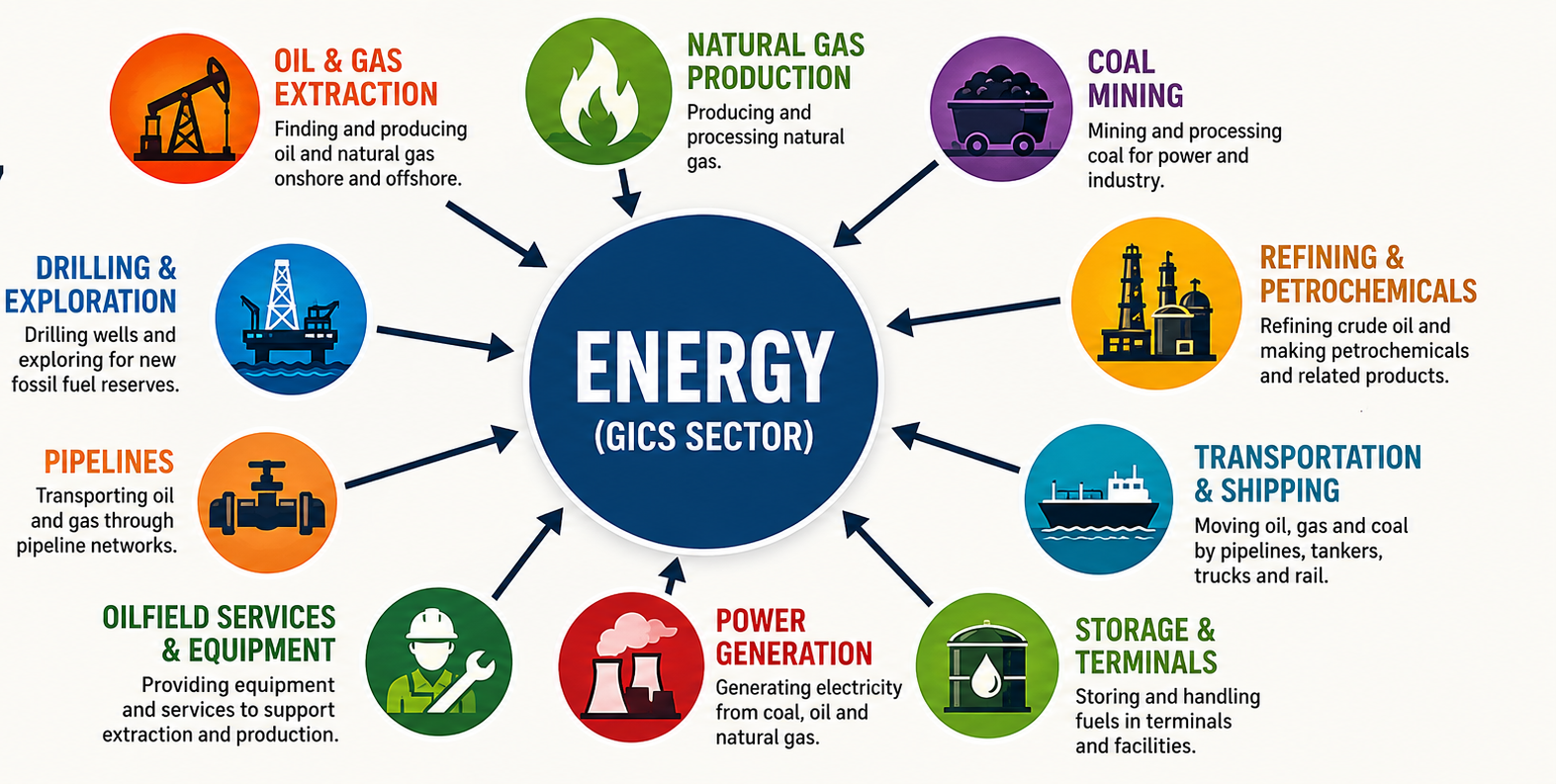
But when it comes to diversification, Big Oil gets a quiet helping hand. Most financial companies rely on the GICS, or Global Industry Classification Standard. This system categorizes every stock in the world according to the primary business activity of the company. Providing a universal nomenclature allows investors to track trends and compare the performance of millions of stocks around the world.
Like the taxonomy you learned in biology class, where large kingdoms contain smaller groups like families and species, the GICS assigns a company to one of 11 large sectors, which are then further subdivided into industry groups, industries, and subindustries. The 11 large sectors are Consumer Staples, Consumer Discretionary, Information Technology, Financials, Health Care, Communication Services, Industrials, Utilities, Materials, Real Estate, and Energy.
If you look up Vanguard’s Employee Benefit Index Fund, you’ll see the careful breakdown of its investments across all 11 sectors. That’s how Vanguard proves that your retirement portfolio is successfully diversified.
But if you look closely, you’ll discover that the GICS stacks the deck in favor of fossil fuels. The “energy” category comprises “oil and gas and coal and consumable fuels” and “companies that offer oil and gas equipment and services.”
In other words, “energy” means fossil fuels (with a few biofuels thrown in). You won’t find renewable energy here. It’s scattered across GICS sectors. Wind turbine companies usually get classified under “industrials,” and solar under “utilities.”
On the surface, your retirement provider seems to be protecting your future by ensuring that you don’t miss out on the energy market. But what it’s really doing is forcing you to sink your savings into climate catastrophe.
Happily, there are fossil-free alternatives. After years of pressuring TIAA to get its clients out of oil, gas, and coal to little result, TIAA-Divest has decided to help people to express their rage by moving their money to more responsible investors.
Knowing that, however, is only the first step. Virginia says, “It feels daunting to think about moving your life savings. And there weren’t supports in place to help me think about the what and the how of doing it.” She was overwhelmed by all the technical terminology, and she worried that she might lose most of her savings.
Eventually, doing research alongside TIAA-Divest volunteers, Virginia found she didn’t need to become an authority on the stock market to move her money. And while it’s true that she won’t be profiting from the latest war, she’s no longer worried about losing her shirt.
Here’s what ordinary people like Virginia need to know.
If you’re already retired, you can shift your retirement savings to a more responsible alternative right now. There’s no penalty for moving the money, and a direct transfer to another retirement account keeps the entire process tax-free. The only exceptions are annuities, which you may not be able to move. (Each annuity contract is specific, and it’s best to ask an investment advisor to make sense of your options.)
If you’re still working and locked into an employer-sponsored plan, it’s complicated — but not impossible — to move your money. Here are three ways to do it:
-
- You may roll over money from any retirement account you have from a previous employer into a new fund.
- Your employer may match your monthly retirement contribution up to a certain amount, and that’s great. But lots of people make additional contributions every month — beyond the match rate. That money is yours, and you can decide to invest it in fossil-free funds.
- About half of all retirement plans include a self-directed brokerage option, often called a brokerage window, which offers a wide range of investments. If your plan offers one, you can usually move your existing balances to fossil-free funds within that window, while staying within your employer’s plan.
Finding the right investment mix for your specific goals and values is the next hurdle. If you want to retire early and you don’t want any of your savings in nuclear power, you’ll have a different set of priorities from your neighbor, who wants to keep working and doesn’t have strong feelings about nuclear energy.
The best option if you already have a decent nest egg is to hire a financial advisor knowledgeable about socially responsible investing. These experts will help you to articulate your priorities, make financial projections, and help you with the nuts and bolts of moving your accounts. Most financial advisors set minimums — $100,000 or $500,000 for a household, for example — though there are some that will invest as little as $5,000 in fossil-free options for you. Advisors typically charge you a percentage of your savings annually. There are a few advisors who charge a flat fee by the hour, no matter how much money you have to invest. Harry Moran, founder of Sustainable Wealth Advisors, who recently spoke with TIAA-Divest, urges prospective clients to choose an advisor who is a fiduciary — that is, legally obligated to avoid conflicts of interest. That means they won’t earn commissions on the funds they recommend to you.
If hiring a financial advisor is out of your reach, you can still make informed choices. Start by opening up Fossil Free Funds, a free and well-respected resource regularly updated by the nonprofit organization As You Sow that grades mutual funds and ETFs by their exposure to fossil fuels. The front page allows you to click on “top-rated funds” to see a list of carefully vetted alternatives. Here you can learn how much each fund invests not only in fossil fuels but also in deforestation, guns, weapons, prisons, and gender equality.
To make sure that your portfolio is diversified enough to protect you against big shocks to the market, search for “balanced” funds, which combine stocks and bonds. (Bonds won’t offer you huge returns, but they will protect you from major market downturns. The standard combination is 60% stocks and 40% bonds.) Once you’ve found a few options you like, you can compare their rates of return by typing the fund names into Fidelity’s “Mutual Funds Research” page or Vanguard’s “Compare ETFS and Mutual Funds” page, which can tell you how well each fund has performed over one, five, and 10 years. The past is no guarantee of future returns, but comparing the fossil-fuel options to your existing accounts will give you a rough sense of how much you stand to lose — or gain — by making the switch.
Virginia successfully moved her retirement savings, except her annuities, to fossil-free investments this year. She’s relieved to have moved her own money, but she still worries about not only her own children and grandchildren, but “all generations to come, especially the most vulnerable among us.” She hopes more people will join the growing chorus of people raising their voices against fossil fuels in retirement portfolios.
Moving our money is one way to show that we really mean it.
And if enough of us do that, the system might also move — for example, by updating the GISC codes, which were last revised in 2023 to reflect major changes in the real estate, retail, and transportation industries.
After all, the energy industry is changing with the times. It’s time for the investment field to catch up.